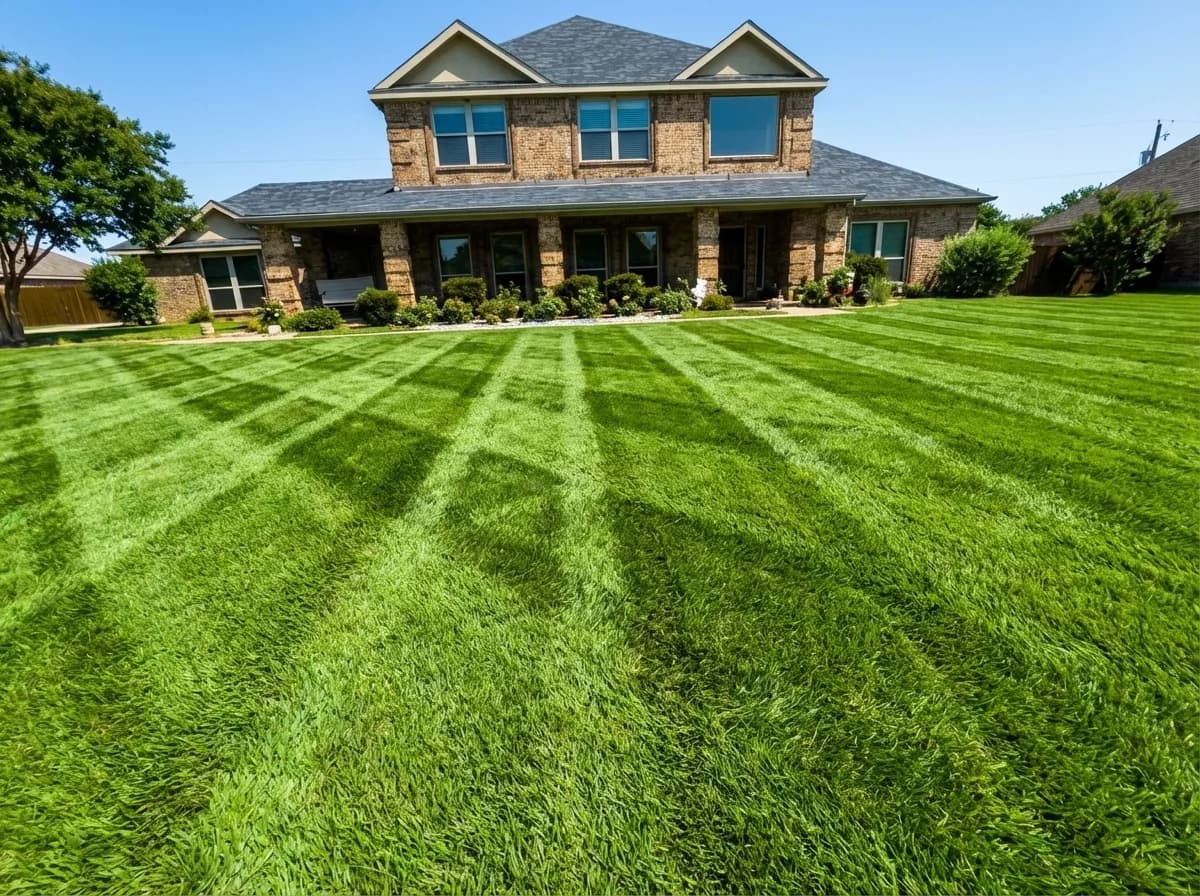
If you have looked into aerating your lawn, you have probably run into two very different ideas wearing the same name. One involves a heavy machine pulling plugs of dirt out of the ground. The other is sprayed on like any other treatment and you would never know it happened by looking. That second one is liquid aeration, and it is what we use on every lawn we service in Rockwall, Heath, Royse City, and the surrounding North Texas area.
This guide explains what liquid aeration actually is, how it is different from mechanical core aeration, and why it fits the heavy clay soil North Texas lawns are built on.
What Is Liquid Aeration?
Liquid aeration is a treatment that loosens compacted soil biologically instead of mechanically. Rather than a machine punching or pulling holes in the ground, a liquid application feeds and activates the soil life that naturally restructures compacted dirt, opening up space for air, water, and nutrients to reach the grass roots.
The kind of liquid aeration we use is a microbial aeration. It works from the inside out: the treatment supports the microbes already living in your soil so they break down compaction and thatch the way healthy soil is supposed to. There is no machine, no plugs pulled up onto the lawn, and no surface disruption. One application keeps working for up to nine months.
Liquid Aeration vs. Core Aeration
Both methods have the same goal, which is relieving soil compaction so grass can root deeply and your lawn program can do its job. They go about it in very different ways.
- Core (mechanical) aeration: a machine pulls plugs of soil out of the lawn or punches holes in it. It works, but it leaves messy soil plugs scattered across the yard, can tear up or catch sprinkler heads, and struggles to treat dense or high-traffic areas evenly.
- Liquid (microbial) aeration: a biological application that restructures compacted soil by feeding the soil life within it. No machine, no plugs, no sprinkler damage, and it covers the entire lawn evenly, including the compacted spots a machine tends to skip.
We do not perform mechanical core aeration. We chose liquid aeration on purpose, because on North Texas clay it does the job without the mess and the sprinkler damage that come with a machine.
Why Liquid Aeration Fits North Texas Clay
The soil under most Rockwall County lawns is heavy clay, and a lot of newer subdivisions sit on graded construction soil that was compacted before the sod ever went down. Compacted clay is exactly the situation aeration is meant to fix: water runs off instead of soaking in, roots stay shallow, and fertilizer and pre-emergents never reach the depth where they work.
Because liquid aeration is applied as a treatment rather than driven as a machine, it reaches the entire lawn, including dense, high-traffic areas where a core aerator bounces or skips. On clay that resists a machine's tines, a biological treatment that loosens the soil from within is a better match.
How It Works With the Rest of Your Lawn Program
Liquid aeration is not a fertilizer, but it makes fertilizer work better. Looser, biologically active soil absorbs nutrients, water, and oxygen more efficiently, so the fertilization and weed control applications in your program go further. Relieving compaction also helps pre-emergents settle into the soil where they stop weeds before they start.
For more on that connection, see how lawn aeration improves weed control and the benefits of lawn aeration for North Texas lawns.
Common Questions
Is liquid aeration the same as microbial aeration?
Yes. Microbial aeration is a liquid-applied treatment, so the terms describe the same thing: a sprayed-on application that loosens compacted soil biologically instead of with a machine.
Does liquid aeration actually work on compacted soil?
It does. By feeding the soil microbes that break down compaction and thatch, liquid aeration restructures the soil so air, water, and nutrients move through it again. One application keeps working for up to nine months, so most lawns do well with a single treatment a year, though heavy clay or heavy foot traffic can benefit from an additional application.
Will it damage my lawn or sprinklers?
No. Nothing mechanical touches the surface, so there are no plugs, no torn turf, and no damaged sprinkler heads. That is one of the main reasons we use liquid aeration instead of core aeration.
When is the best time for liquid aeration?
The timing is flexible because there is no surface disruption. It can be applied in spring, summer, or fall, even in the heat when mechanical aeration would stress a lawn, so we coordinate it around what your lawn needs rather than around when a machine can be scheduled.
Not Sure If Your Lawn Needs Aeration?
If your lawn pools water after rain, feels hard underfoot, or greens up slowly no matter how much you water, compaction is a likely cause. Our estimate is free: we look at your lawn's condition, tell you honestly whether compaction is what is holding it back, and build a treatment plan around what your lawn actually needs. Every application is made by a professional licensed by the Texas Department of Agriculture, and everything we do is backed by our 100% guarantee with no contracts.